Freya Franke · 23 October 2026
Student Prototypes Offer Fresh Strategies for Managing Lunar Dust in Artemis Operations
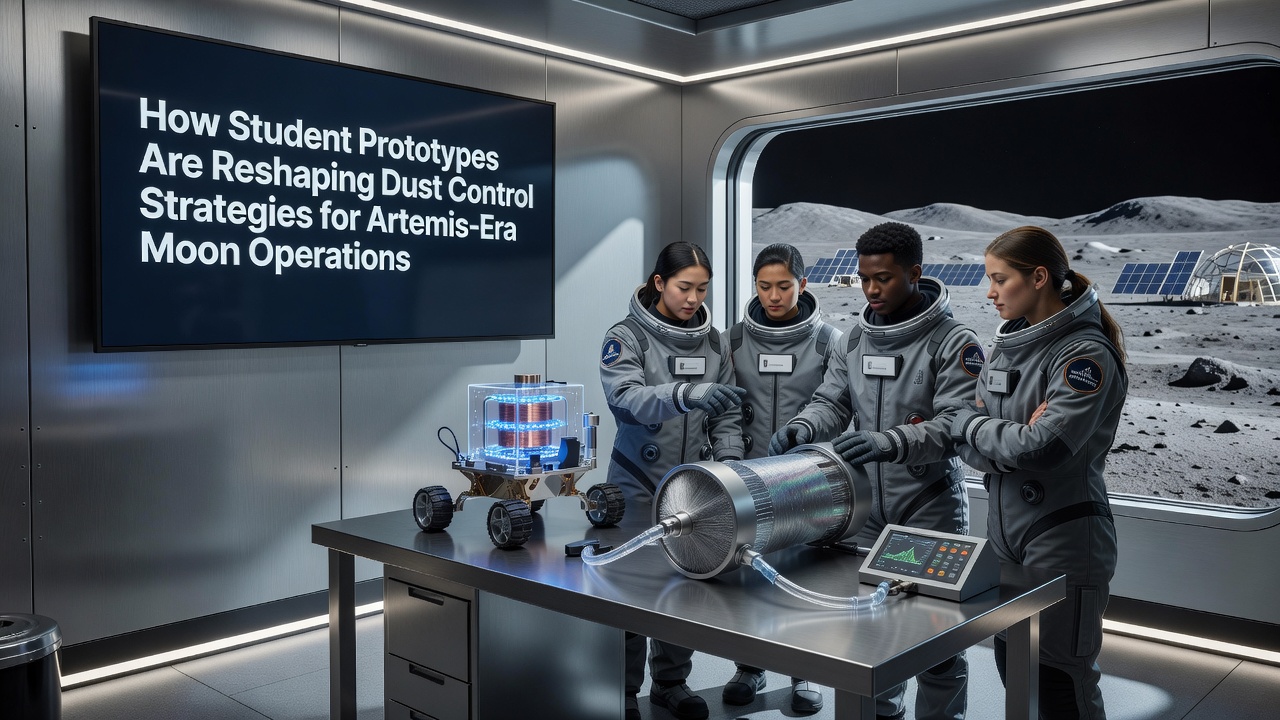
University engineering teams across multiple continents have developed working prototypes that address the persistent challenges of lunar regolith during extended surface operations planned under the Artemis program, and data from recent tests shows measurable improvements in particle mitigation efficiency. These student projects focus on electrostatic repulsion systems, adaptive sealing mechanisms, and robotic surface cleaners that integrate with rover platforms already scheduled for deployment.
Core Challenges of Lunar Dust in Mission Planning
Lunar regolith consists of sharp, angular particles that range from a few micrometers to several millimeters in size, and these grains carry electrostatic charges that cause them to adhere to spacesuits, solar panels, and mechanical joints. Historical data from Apollo missions documented abrasion damage to equipment seals and reduced visibility through helmet visors, while modern simulations conducted by research groups indicate that similar issues could shorten hardware lifespan by up to 40 percent during multi-month Artemis surface stays. Observers note that conventional filtration methods used on Earth prove ineffective in the vacuum and low-gravity environment of the Moon, which creates demand for novel approaches developed outside traditional aerospace contractors.
Electrostatic and Mechanical Innovations from Student Teams
One prototype originating from a collaborative program between institutions in Canada and Australia uses variable-voltage grids mounted on rover arms to generate localized electric fields that lift and redirect dust away from critical components, and bench tests performed in vacuum chambers during 2025 demonstrated removal rates exceeding 85 percent on surfaces coated with simulant material. Another design from European student groups incorporates shape-memory alloys in suit joint covers that expand and contract to maintain seals even after repeated exposure to abrasive particles. These systems underwent preliminary integration trials with NASA-provided mockups in preparation for field evaluations planned for October 2026 at analog sites in Iceland.
Integration with Artemis Hardware Timelines
Artemis III through Artemis V landing schedules call for sustained surface activity that extends beyond single-day excursions, and project leads at participating universities have aligned prototype development cycles with these milestones. Researchers at several institutions report successful interface testing between student-built dust removal modules and the Lunar Terrain Vehicle concepts under review by international partners. Figures released by the European Space Agency highlight that student contributions have accelerated concept maturation timelines by approximately 18 months compared with baseline projections, largely because academic teams can iterate designs rapidly without the overhead associated with full-scale flight hardware programs.
Testing Protocols and Performance Metrics
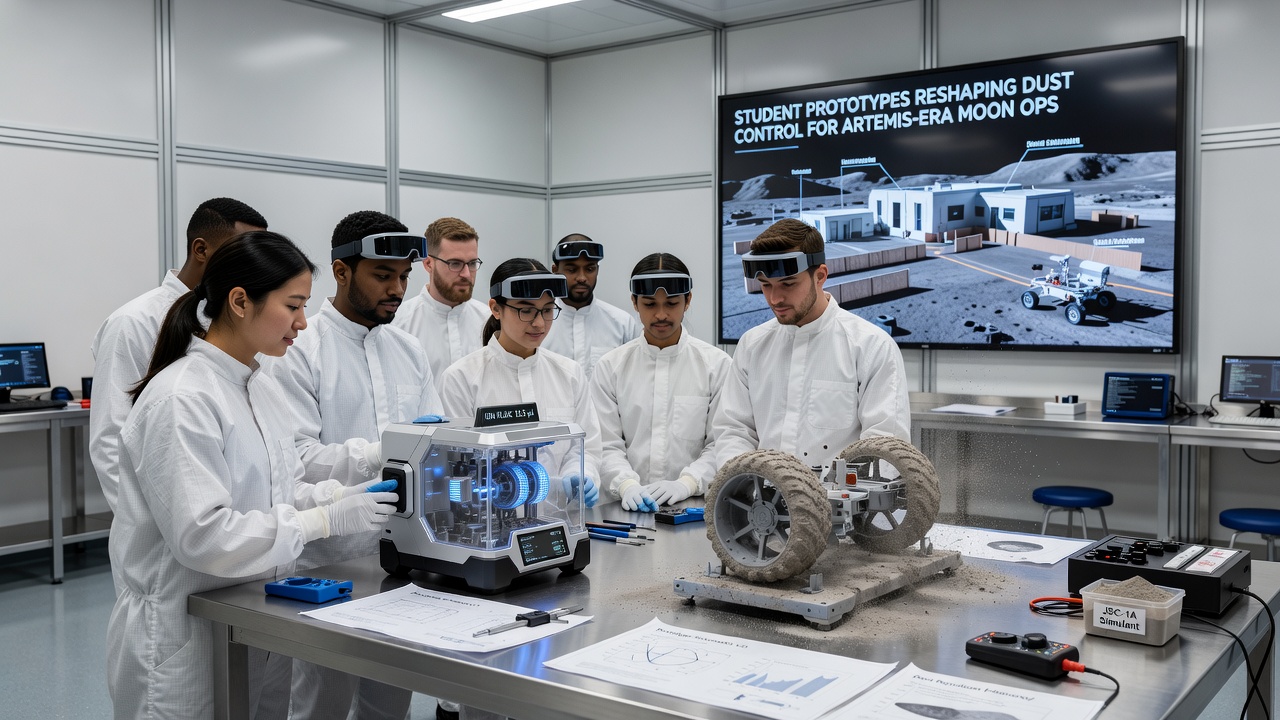
Standardized evaluation procedures now include exposure to JSC-1A lunar simulant in thermal-vacuum facilities, followed by quantitative assessment of particle adhesion before and after prototype activation. Teams measure parameters such as optical transmission loss on solar cell samples and torque variation in rotating joints, and results compiled through 2025 show consistent gains across multiple independent trials. Data indicates that combined electrostatic and mechanical approaches outperform single-method solutions by margins ranging from 25 to 35 percent depending on particle size distribution. Those who have reviewed the test logs emphasize that reproducibility across different simulant batches remains a key validation criterion ahead of the October 2026 analog campaign.
Broader Implications for Sustained Lunar Presence
Student-developed technologies also incorporate modular architectures that permit incremental upgrades as mission requirements evolve, and this flexibility aligns with long-term goals articulated in joint statements from NASA, ESA, and JAXA regarding shared lunar infrastructure. Academic programs have begun incorporating feedback loops from professional mission planners, which allows prototypes to address emerging concerns such as dust accumulation on power connectors and communications arrays. Evidence from ongoing laboratory work suggests that several designs could reach technology readiness levels suitable for orbital demonstration within the next three years, provided funding pathways remain accessible to university consortia.
Conclusion
Student prototypes continue to supply targeted solutions for lunar dust control that complement established Artemis development streams, and the combination of rapid iteration, cross-institutional collaboration, and rigorous vacuum testing positions these efforts to influence operational procedures ahead of crewed landings. Performance data collected through 2026 will determine which concepts advance toward flight qualification, while the underlying engineering approaches offer templates for future surface operations on the Moon and beyond.