Freya Franke · 2 September 2026
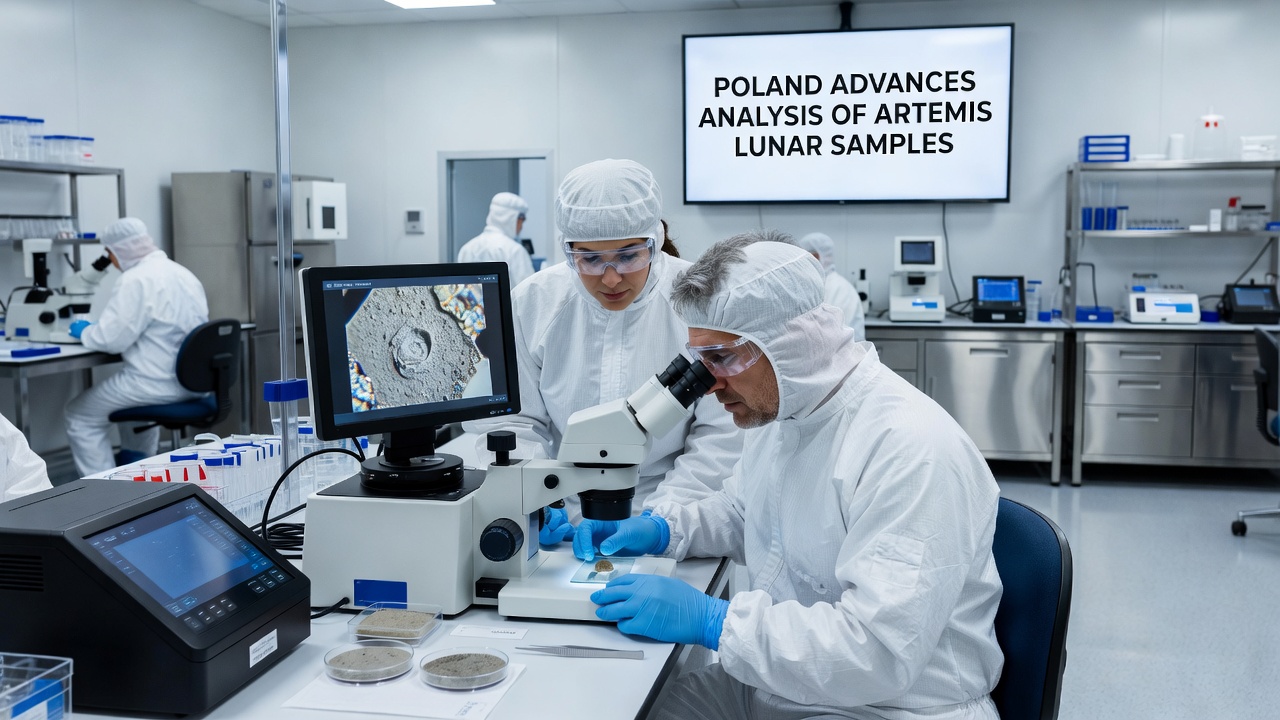
Poland has made notable progress in the analysis of lunar samples collected during the Artemis missions led by NASA. Polish scientists are utilizing state-of-the-art facilities to examine materials brought back from the Moon, contributing valuable data to the global scientific community. This involvement highlights the growing capabilities of Polish research institutions in the field of lunar science and exploration.
Polish Institutions Leading Sample Analysis
The Institute of Geological Sciences at the Polish Academy of Sciences has established specialized laboratories for handling extraterrestrial samples. Researchers there employ X-ray diffraction and mass spectrometry to identify mineral components and trace elements in the lunar regolith. These methods allow for precise characterization of the samples' chemical makeup, revealing information about the Moon's geological history and volcanic activity. Collaborations with the Nicolaus Copernicus Astronomical Center enable integration of astronomical observations with sample data. Teams in Wroclaw focus on volatile compounds, which are crucial for understanding water resources on the Moon. Such studies support plans for resource utilization in future lunar bases.
Impact on International Lunar Research
The results from Polish analyses are shared through international databases, enhancing the collective knowledge from Artemis sample returns. This cooperation fosters advancements in understanding the Moon's formation and its relationship to Earth. Polish contributions also include development of software for data processing, improving efficiency in sample examination worldwide. Training programs for young researchers ensure continuity in expertise. National grants have funded equipment upgrades necessary for handling sensitive materials without contamination. The work aligns with European Space Agency objectives, positioning Poland prominently in space exploration efforts. Future missions may benefit from these refined analytical protocols developed through current projects. Overall, these efforts underscore Poland's commitment to advancing lunar science, with potential applications extending to other planetary bodies. Scientists anticipate that continued analysis will yield breakthroughs in astrobiology and resource prospecting on the lunar surface.